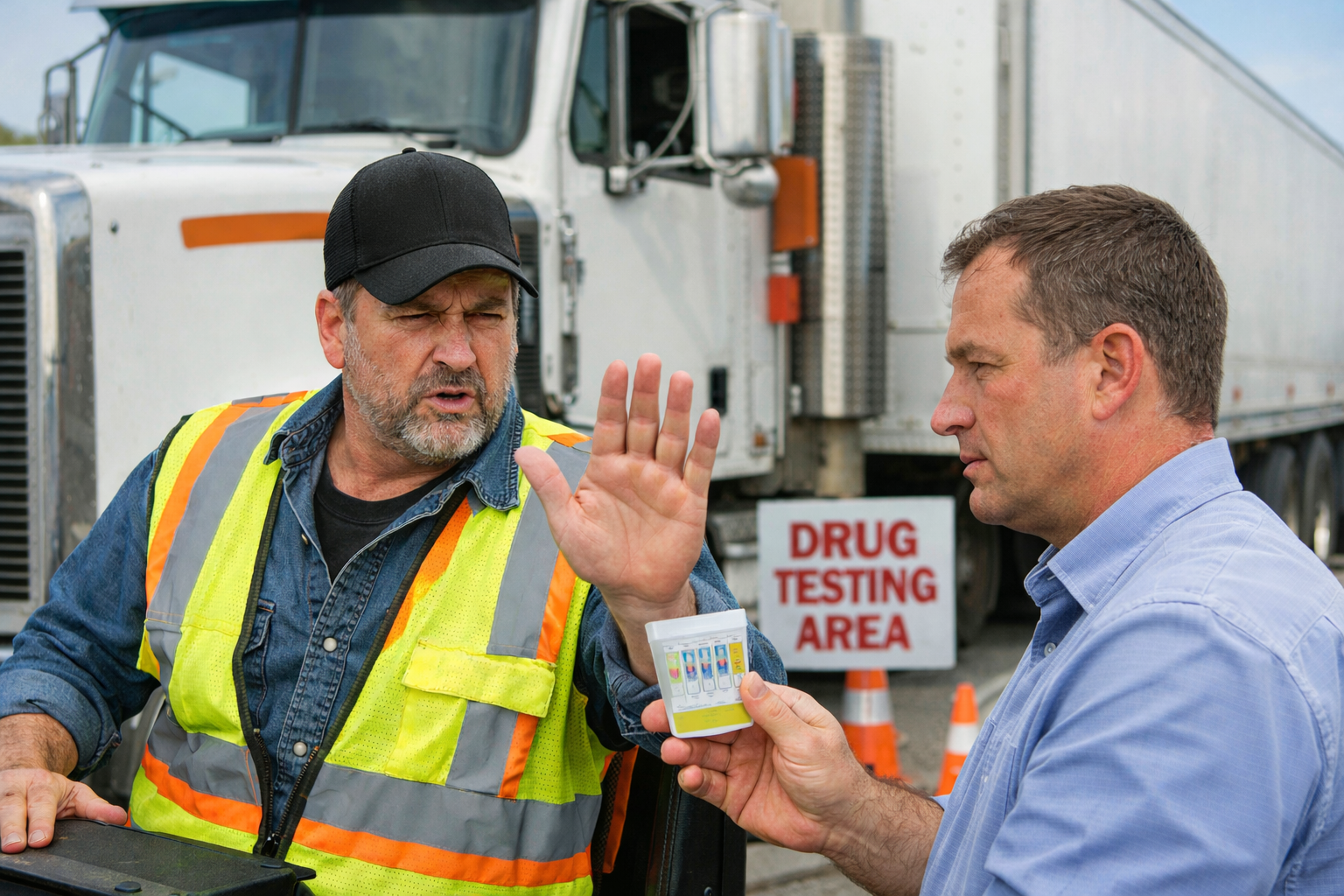
A DOT test refusal is one of the most serious violations under federal transportation regulations. When a driver refuses to complete a required drug or alcohol test, the law treats it the same as a positive drug test result.
For employers regulated by the Federal Motor Carrier Safety Administration (FMCSA), a refusal triggers immediate compliance obligations.
If the employer does not respond correctly, they could face serious penalties, audits, or civil fines.
This guide explains:
- What counts as a DOT drug test refusal
- The 7 situations considered a refusal
- What employers must do immediately
- How to remain compliant with federal regulations
What Is a DOT Drug Test Refusal?
Under federal regulations (49 CFR Part 40), a refusal to test occurs when a safety-sensitive employee fails to cooperate with the drug or alcohol testing process.
A refusal is treated exactly like a verified positive test and must be reported to the FMCSA Drug & Alcohol Clearinghouse.
Once a refusal occurs:
- The driver must be immediately removed from safety-sensitive duties
- They cannot operate a commercial motor vehicle
- They must complete the Return-to-Duty (RTD) process
The 7 Situations That Count as a DOT Test Refusal
Many employers believe a refusal only happens when a driver directly says “I refuse the test.”
In reality, several actions legally count as refusals.
1. Failing to Appear for a Test
If a driver does not show up for a scheduled test after being notified, this is considered a refusal.
Examples include:
- Ignoring instructions to report for testing
- Leaving work without completing the test
2. Leaving the Testing Site Before Completing the Test
Drivers must remain at the collection site until the testing process is complete.
Leaving early—even before providing a specimen—counts as a refusal.
3. Failing to Provide a Urine Sample Without Medical Explanation
If a driver cannot produce enough urine and has no valid medical explanation, it is considered a refusal.
The Medical Review Officer may evaluate potential medical causes.
4. Refusing an Observed Collection
Observed collections occur when:
- The initial test result is invalid
- There is evidence of tampering
- The specimen temperature is abnormal
Refusing an observed collection is classified as a refusal.
5. Tampering With the Specimen
Any attempt to manipulate the testing process is a refusal.
Examples include:
- Using synthetic urine
- Adding chemicals
- Substituting a specimen
6. Failing to Permit an Alcohol Test
Drivers must cooperate with breath or saliva alcohol testing.
Refusal includes:
- Not blowing into the breath device
- Interfering with the test procedure
7. Not Following Instructions From the Collector
Failure to cooperate with reasonable instructions during testing also counts as refusal.
Examples include:
- Refusing to remove outer clothing
- Not emptying pockets when requested
- Interfering with the testing process
What Employers Must Do Immediately After a Refusal
Employers regulated by **U.S. Department of Transportation rules must act immediately.
Failure to follow proper steps can result in compliance violations.
Step 1: Remove the Driver From Safety-Sensitive Duties
The driver must immediately stop performing safety-sensitive functions, including operating a commercial motor vehicle.
Step 2: Document the Refusal
Employers must maintain records documenting:
- The refusal incident
- The test type
- Time and location of the event
Proper documentation is critical during audits.
Step 3: Report the Violation to the Clearinghouse
Employers must report the violation to the FMCSA Clearinghouse.
This federal database tracks drug and alcohol violations across the industry.
Step 4: Provide SAP Referral
The driver must be referred to a Substance Abuse Professional (SAP).
The SAP will determine:
- Required treatment
- Education requirements
- Eligibility for return-to-duty testing
Step 5: Begin the Return-to-Duty Process
Before returning to safety-sensitive work, the driver must complete:
- SAP evaluation
- Treatment or education program
- Return-to-duty drug test
- Follow-up testing plan
Common Employer Mistakes After a Refusal
Employers frequently make errors when handling refusal cases.
Not Removing the Driver Immediately
Drivers must stop performing safety-sensitive work immediately after refusal.
Failing to Report the Violation
Failure to report violations to the Clearinghouse can result in federal penalties.
Poor Recordkeeping
DOT audits frequently cite companies for missing documentation.
Not Understanding Testing Rules
Small carriers often misunderstand testing procedures, particularly when managing their own programs.
How a Third-Party Administrator Helps Employers Stay Compliant
Managing DOT drug testing internally can be complex.
Many employers rely on Third-Party Administrators (TPAs) to ensure full compliance with federal regulations.
A professional TPA can assist with:
- Random testing program management
- Clearinghouse reporting
- Refusal documentation
- SAP referrals
- Compliance recordkeeping
This reduces the risk of violations during FMCSA audits.
Final Thoughts
A DOT drug test refusal is a serious violation that requires immediate action from employers.
Understanding the rules helps protect your company from compliance penalties while ensuring roadway safety.
Employers should ensure they have systems in place to properly manage:
- Testing programs
- Clearinghouse reporting
- Documentation requirements
For many companies, partnering with an experienced compliance provider is the easiest way to stay compliant.
Need Help Managing DOT Drug Testing?
If your company needs help managing DOT drug testing compliance, the team at Excel Screen can help.
Our services include:
- DOT random consortium enrollment
- Clearinghouse compliance
- Drug and alcohol testing management
- Employer compliance support
Visit www.xcelscreen.com to learn how we help employers stay compliant.