What Happens If You Fail a DOT Drug Test?
From immediate removal to getting your CDL back — a complete, no-fluff guide for drivers and fleet owners.
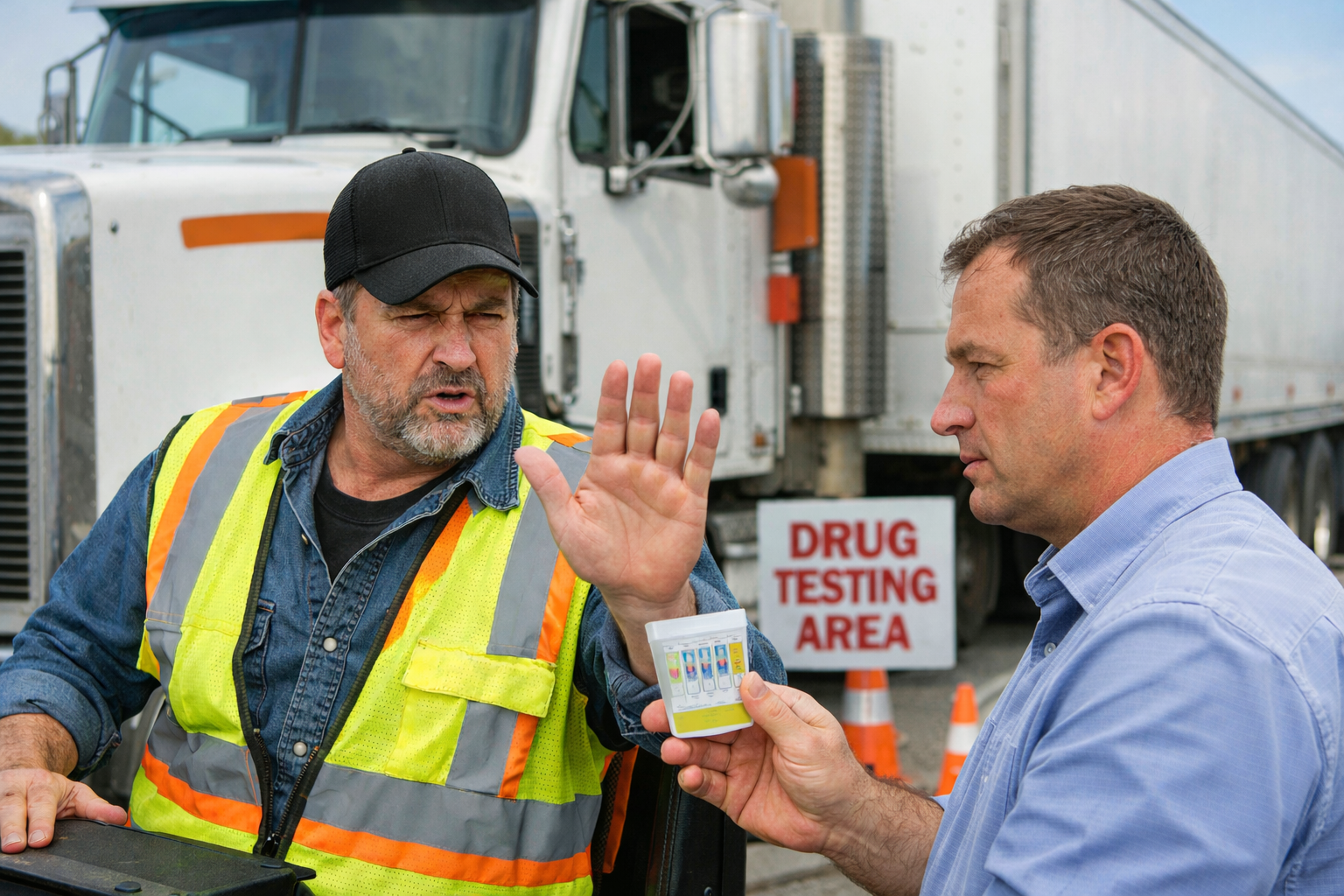
Failing a DOT drug test is one of the most serious compliance events a commercial driver or fleet owner can face. It doesn't just affect one test — it triggers a federal process that can sideline a driver for 12+ months, impact your CDL status, and follow you in the FMCSA Clearinghouse for up to five years.
The good news: it's not automatically the end of your driving career. But you need to understand exactly what happens and act fast.
This guide covers everything — what triggers a failure, the immediate consequences, the Return-to-Duty process, and most importantly, how to protect yourself and stay compliant going forward.
What Is a DOT Drug Test?
A DOT drug test is a federally mandated drug screening required for employees in safety-sensitive transportation roles. For commercial truck drivers, the testing program is governed by the Federal Motor Carrier Safety Administration (FMCSA) under 49 CFR Part 382 and 49 CFR Part 40.
DOT drug tests are required in several situations:
- Pre-employment — before driving for a new employer
- Random testing — unannounced, year-round (FMCSA requires 50% of drivers annually for drugs)
- Post-accident — after certain crashes involving a CMV
- Reasonable suspicion — when a supervisor observes signs of drug or alcohol use
- Return-to-Duty — after a previous violation, before resuming driving
- Follow-up — continuing tests after Return-to-Duty
Owner-operators and small fleets are required by FMCSA to participate in a random drug and alcohol testing program through a DOT-registered consortium. Excel Screen offers enrollment for just $89.99/year with unlimited drivers and full compliance management.
What Substances Does a DOT Drug Test Screen For?
All DOT drug tests use the federally standardized 5-panel urine test defined in 49 CFR Part 40. Employers cannot add or remove substances from this panel.
| Substance Category | What It Detects | Key Note |
|---|---|---|
| 🌿 Marijuana (THC) | Cannabis metabolites | Illegal under federal law — state medical/recreational cards offer NO protection |
| ❄️ Cocaine | Benzoylecgonine (metabolite) | Clears relatively quickly, but still detectable days after use |
| 💊 Opioids | Codeine, morphine, heroin, oxycodone, hydrocodone, oxymorphone, hydromorphone | Prescription opioids can still cause a positive — MRO review required |
| ⚡ Amphetamines | Amphetamine, methamphetamine, MDMA, MDA | Includes Adderall and Ritalin — disclosure and MRO review required |
| 🔮 PCP | Phencyclidine | Longer detection window (7–14 days even for occasional use) |
The DOT follows federal law, where marijuana remains a Schedule I controlled substance. Even drivers in states with legal recreational or medical cannabis will fail a DOT test if THC is detected — regardless of any card, prescription, or state law.
What Happens Immediately After Failing a DOT Drug Test?
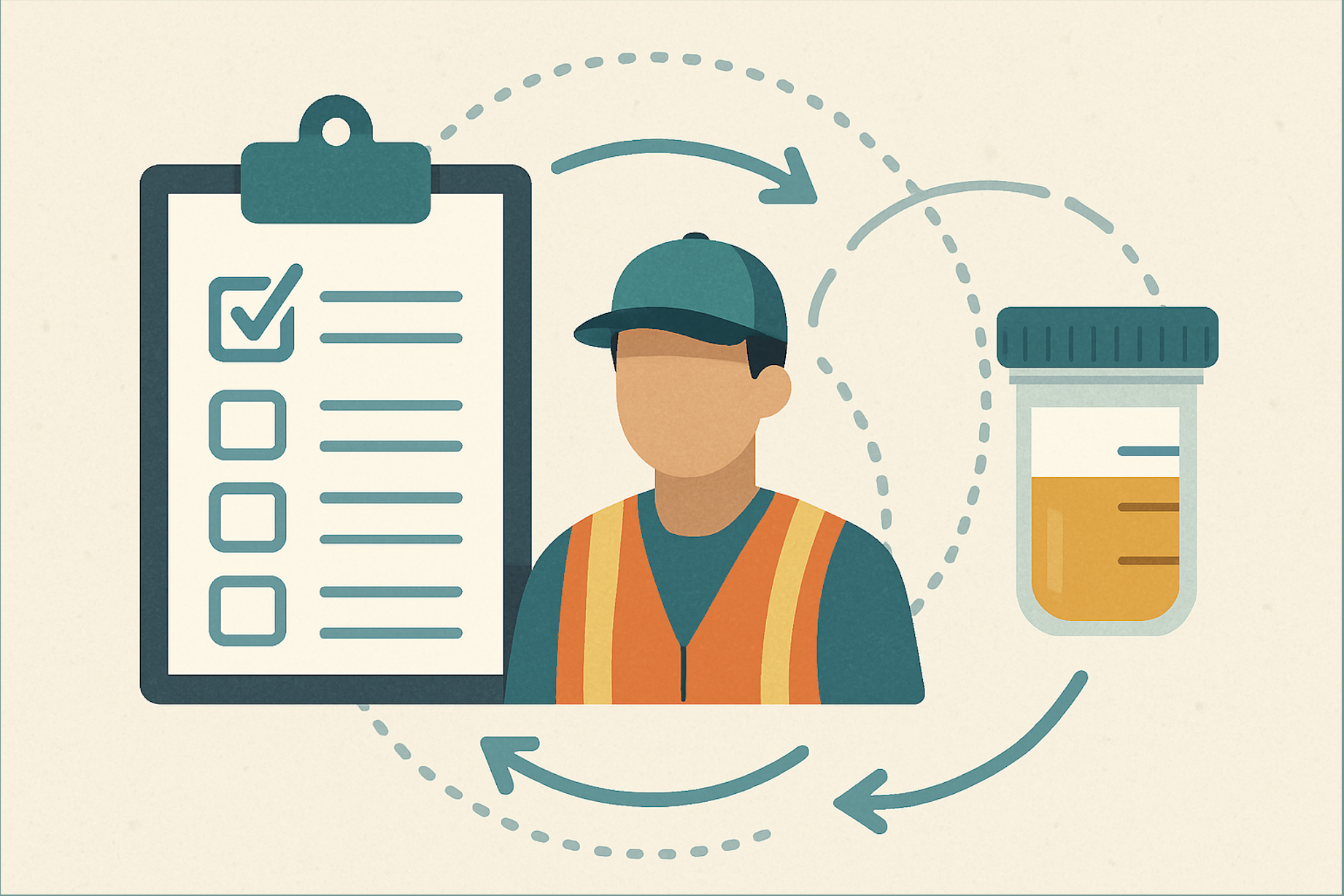
The moment a positive result is confirmed by a Medical Review Officer (MRO), the consequences are swift and automatic. Here's what happens step by step:
Immediate Removal from Safety-Sensitive Duties
You are immediately and legally prohibited from performing any safety-sensitive functions, which means no driving a commercial motor vehicle (CMV). This removal is non-negotiable and mandatory under federal law. You cannot drive even one more shift.
MRO Reports to FMCSA Clearinghouse (Within 2 Business Days)
The Medical Review Officer is required to report your positive test result to the FMCSA Drug and Alcohol Clearinghouse within 2 business days. Your status is immediately updated to "Prohibited."
Your Employer Is Notified
Your Designated Employer Representative (DER) is informed. Your employer is legally required to remove you from driving duties and provide you with a list of qualified Substance Abuse Professionals (SAPs) in your area.
CDL Downgrade Risk
Since a 2024 FMCSA rule change, drivers with a "Prohibited" status who don't begin the Return-to-Duty process will have their CDL downgraded by the State Driver Licensing Agency (SDLA). New CDL applications will also be denied until the status is cleared.
Any employer who knowingly allows a driver in "Prohibited" status to operate a CMV faces an average federal penalty of $5,652 per incident. Drivers face personal legal liability as well. This is not a gray area.
What happens in the hours and days after a positive DOT drug test result.
The FMCSA Clearinghouse & Your CDL
The FMCSA Drug and Alcohol Clearinghouse is a federal database that tracks drug and alcohol violations for all CDL drivers. It's the most consequential part of a failed DOT test for long-term employment.
What Goes Into the Clearinghouse?
- Positive drug or alcohol test results
- Refusals to test (treated the same as a positive)
- RTD test completion
- Follow-up testing completion
- SAP evaluation dates
How Long Does It Stay?
A violation remains in your Clearinghouse record for 5 years from the date of the violation, or until you have completed all required follow-up testing — whichever is later. This means if you take more than 5 years to complete follow-up testing, the record stays until you're done.
Who Can See It?
Every prospective or current employer must query the Clearinghouse before hiring a CDL driver and at least annually for current drivers. This means a violation will show up whenever any regulated employer looks you up — nationwide.
"As of April 1, 2025, there were over 184,000 drivers in prohibited status in the DOT Clearinghouse — and 142,725 of them hadn't even started the Return-to-Duty process."
What Will Your Employer Do?
What happens with your job after a failed DOT drug test depends on your employer's policies, but there are federal minimums that every employer must follow:
- Remove you from all safety-sensitive duties immediately
- Provide you with a list of DOT-qualified SAPs in your area
- Report the violation to the FMCSA Clearinghouse
- Not allow you to return to driving until the full RTD process is complete
Many employers, especially larger carriers, will terminate employment after a positive test. Smaller operations may keep you on in a non-driving capacity while you complete the Return-to-Duty process. That decision is entirely up to the employer — federal law only governs what you must do before driving again, not whether you keep your job.
If you're an owner-operator, a failed test means you must remove yourself from driving and follow the RTD process — there's no employer to manage this for you. This is exactly why being enrolled in a DOT consortium like Excel Screen matters: your consortium can help guide you through what comes next.
The Return-to-Duty (RTD) Process: Step by Step
The Return-to-Duty process is the only legal path back to driving a CMV after a DOT drug or alcohol violation. It's a structured, federally mandated program designed to ensure you're substance-free and safe to return to the road.
Contact a Substance Abuse Professional (SAP)
Your first step is to find and contact a DOT-qualified Substance Abuse Professional. Your employer must provide a list. SAPs are licensed clinical professionals (counselors, social workers, psychologists) specifically certified to conduct DOT evaluations. You choose who you work with.
Initial SAP Evaluation
The SAP conducts a face-to-face evaluation to assess the nature and severity of your substance use. Based on this, they create a recommended treatment or education program tailored to your situation. The SAP's recommendation is not negotiable — you must comply with whatever is prescribed.
Complete the Prescribed Treatment or Education
This could range from an education program (for lower-severity cases) to outpatient or inpatient rehabilitation. The timeline varies depending on the SAP's assessment — most evaluations run 2 to 6 months. You cannot schedule the RTD test until the SAP confirms you've completed the program.
SAP Follow-Up Evaluation
After treatment, the SAP conducts a second evaluation to determine whether you're eligible for the Return-to-Duty drug test. Only the SAP — not your employer, not you — can authorize this test. All authorization records are reported to the FMCSA Clearinghouse.
Pass the Return-to-Duty (RTD) Drug Test
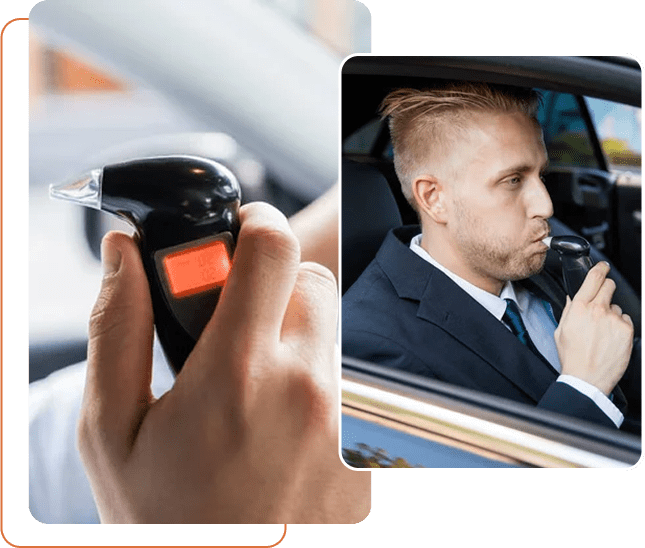
You must pass a directly observed drug test with a verified negative result. For alcohol violations, the test must show a BAC below 0.02. If you fail this test, the entire process restarts — another SAP evaluation, new treatment, new testing. Your employer must report the negative result to the Clearinghouse within 3 business days.
Follow-Up Testing Program
Once you're back driving, you're placed on a follow-up testing schedule determined by the SAP. The minimum is 6 unannounced tests in the first 12 months, all conducted under direct observation. The SAP may require more than 6 tests and can extend the program up to 5 years.
The DOT's RTD process is not punitive by design — it's a structured rehabilitation pathway. Drivers who follow it completely and honestly can return to driving. The system penalizes those who try to avoid it, not those who engage with it.
Full Timeline: How Long Does the Return-to-Duty Process Take?
Many drivers want to know: how long will I be off the road? The honest answer: at minimum 12.5 months, and often longer depending on your SAP's recommendations and how quickly you complete each step.
Positive Test Confirmed
MRO verifies result, reports to Clearinghouse, employer notified. You are immediately removed from driving duties.
SAP Evaluation
You contact and meet with a qualified SAP for your initial evaluation. The faster you do this, the faster the clock starts.
Treatment or Education Program
You complete whatever the SAP prescribes. This typically takes 2–6 months, but can be longer for more serious cases.
SAP Re-Evaluation & RTD Test
SAP confirms program completion, authorizes RTD test. You pass a directly observed negative drug test. Your employer can reinstate your driving duties.
Follow-Up Testing Begins (12 Months)
Minimum 6 unannounced tests over the next 12 months. All under direct observation. You must pass every one.
Process Complete
Once all follow-up tests are passed, the RTD process is officially complete. The violation remains in the Clearinghouse for 5 years total, but your status is no longer "Prohibited."
Does a Failed DOT Drug Test Show Up on a Background Check?
This is one of the most common questions drivers ask. The answer is nuanced:
- ✅ Criminal background check — A failed DOT drug test does not appear on a standard criminal background check. It is not a criminal conviction.
- 🚨 FMCSA Clearinghouse — It absolutely shows up here. Any prospective DOT-regulated employer is legally required to query the Clearinghouse before hiring you, so every regulated trucking or transportation employer will see it.
- 📋 Previous employer inquiries — Prior employers must respond truthfully to queries about your drug and alcohol test history under federal regulations.
The practical effect: while it won't show on a background check a landlord runs, it will be visible to any regulated carrier considering hiring you for a CDL position.
What If You Refuse a DOT Drug Test?
Under federal regulations, refusing to submit to a DOT drug or alcohol test is treated exactly the same as testing positive. It triggers the same immediate removal from safety-sensitive duties and the same Return-to-Duty requirements.
Refusals include:
- No-showing for a scheduled test without a valid reason
- Leaving the collection site before the test is complete
- Providing an insufficient sample without a valid medical explanation
- Adulterating or substituting a specimen
- Failing to provide a second specimen when directed
Many drivers assume refusing is a way to avoid a positive result. It isn't. A refusal is reported to the Clearinghouse just like a failed test, triggers the same consequences, and requires the same RTD process to clear.
How to Stay Compliant and Avoid This Situation
The best outcome is never being in this situation in the first place. Here's how drivers and fleet owners can stay protected:
For Drivers
- Know your substances: THC stays detectable in urine for weeks with regular use. Don't assume you've cleared it.
- Prescription medications: Always inform the Medical Review Officer about any prescriptions before your test. The MRO review process exists to protect you — but only if you're upfront.
- Supplements and CBD: Many supplements contain trace THC. "THC-free" labels are not federally regulated. Exercise caution.
- Know your testing schedule: Understand when random tests can happen and stay informed through your consortium.
For Fleet Owners and Owner-Operators
- Enroll in a DOT-compliant consortium: This is a federal requirement for FMCSA-regulated carriers. Your consortium manages random testing selection, notifications, and compliance records.
- Never allow a driver in "Prohibited" status to drive: The average federal penalty is $5,677 per incident.
- Query the Clearinghouse before every hire: Legally required. Skipping this step exposes your company to serious liability.
- Keep good records: All test results, SAP reports, and RTD documentation must be retained for at least 5 years.
Excel Screen is a DOT-registered consortium serving owner-operators and fleets nationwide. For $89.99/year, you get unlimited drivers, random testing management, online scheduling, and a compliance certificate for DOT audits. Enroll online in minutes →
Frequently Asked Questions
Don't Wait Until There's a Problem
Stay FMCSA-compliant with a DOT consortium that's simple, affordable, and built for truckers. Enroll in minutes online — unlimited drivers, full compliance support.
Enroll Now — $89.99 / Year See All Services